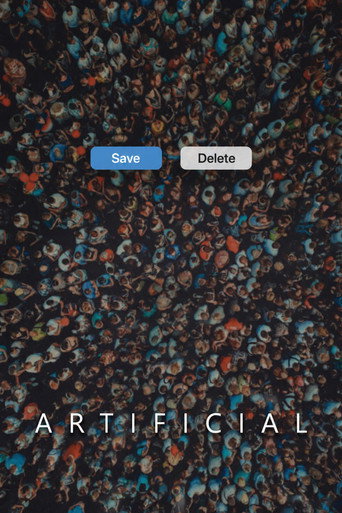
In a flooded future where rising sea levels have devastated the Earth, advanced robotic mechas serve humanity. A grieving couple, Henry and Monica Swinton, adopt David, an experimental child robot programmed to feel genuine love. Although Monica initially hesitates, she eventually activates his imprinting protocol, making David deeply devoted to her. Complications arise when the couple's biological son, Martin, miraculously recovers from a rare disease and returns home.
Jealousy and tension fracture the household as Martin maneuvers David into erratic behavior. Following a terrifying pool incident where David's self-protection programming triggers, Henry persuades Monica that the robot child poses a danger to their family. Unwilling to let him be destroyed, Monica abandons David in a desolate forest alongside his companion, Teddy. Clinging to the story of Pinocchio, David embarks on a desperate quest to find the Blue Fairy so she can transform him into a real boy and win back Monica's affection. Along his journey, he encounters the Flesh Fair, escapes with Gigolo Joe, and travels through flooded ruins.
What happens at the end of Artificial?
Key takeaways
David spends thousands of years trapped underwater praying to a statue until advanced mechas rescue him.
The futuristic beings resurrect Monica for a single day using a preserved strand of hair.
David experiences his ultimate wish by sharing one perfect, final day with his mother.
One interpretation is that the story explores the tragic pursuit of love and what truly makes someone real.
The final act of Artificial begins when David and Teddy reach the flooded ruins of New York City and find Professor Hobby at Rockefeller Center. Hobby reveals that David's journey, desires, and yearning to dream prove his capacity for authentic emotion. However, upon discovering a mass-production line of robotic duplicates, David's sense of uniqueness shatters. Overwhelmed by despair, he leaps from a skyscraper into the ocean below. Gigolo Joe rescues David in an amphibious aircraft, but authorities quickly apprehend Joe using an electromagnet. Taking control of the vehicle, David and Teddy fly toward a dilapidated statue of the Blue Fairy at Coney Island. The Wonder Wheel collapses on top of their aircraft, trapping them beneath the water. Believing implicitly in the magic of the fairy, David endlessly begs the stone figure to make him a real boy until his internal power source finally drains away.
Two millennia pass, and humanity has vanished from the Earth while Manhattan lies encased beneath thick glacial ice. Highly evolved mecha beings, referred to as Specialists, discover David and Teddy frozen in the ruins. They thaw and resurrect the two companions, using David's vivid memories to reconstruct the exact interior of the Swinton family home. Through a holographic projection of the Blue Fairy, the advanced mechas inform David that human resurrection is impossible and that he can never truly become a biological boy. Yet, utilizing a preserved lock of Monica's hair that Teddy safeguarded for centuries, the Specialists successfully clone a temporary version of Monica. This resurrected Monica can only survive for twenty-four hours and cannot be brought back again. David spends his long-awaited, blissful day with his mother, experiencing unconditional maternal affection at last. As evening arrives and Monica peacefully drifts off to sleep, she whispers that she has always loved him. David lies down right beside her, closing his eyes in a moment of profound peace while loyal Teddy watches over them.
What does the ending of Artificial mean?
One interpretation of Artificial is that it examines the timeless human desire for belonging and parental validation through a mechanical lens. David's relentless pursuit to become a real boy is not merely about physical transformation, but about proving his worth and emotional depth to a mother who abandoned him. The film investigates the nature of consciousness and connection, suggesting that capacity for suffering and devotion can transcend biological origins.
Another reading is that the story highlights the tragic irony of creation, where a sentient being is engineered to love unconditionally in a world incapable of reciprocating that devotion. The distant future depicted by the advanced mechas recontextualizes human history as a mythic era, leaving open the question of whether artificial creations can ever truly inherit the soul of their makers.
Average audience ratings from the source database. Click a title to read its ending explained.
Artificial ending FAQ
Who is David in Artificial?
David is an innovative prototype mecha child created by Professor Hobby, engineered specifically with the unique ability to experience and reciprocate genuine love.
Why does Monica abandon David in the forest?
Monica leaves David in the woods because Henry fears for their family's safety after a dangerous pool incident, convincing her that the robot child must be discarded.
What happens to humanity by the end of the story?
Humanity is allegedly extinct on Earth, and Manhattan is completely buried under thick glacial ice when advanced mechas discover David two thousand years later.
How is Monica brought back to life?
The advanced mecha Specialists recreate Monica using preserved genetic material extracted from a lock of hair that Teddy had kept in his pocket.
Does David finally become a real boy?
No, the futuristic Specialists explain that he cannot become human, but they grant him his ultimate wish by giving him one perfect day with Monica.