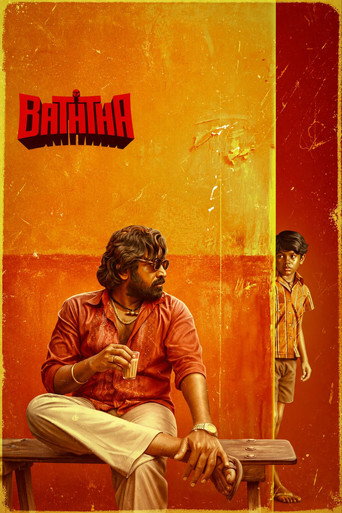
Set in 1986 Madras, Baththavachalam, known locally as Baththa, rules the streets through brutal force and intimidation. Despite his ruthless public persona, he shows a softer side toward his teenage daughter Thenu, while routinely mistreating his wife Kannima. In the same neighborhood lives Sabhari, a timid young boy who is deeply terrified of Baththa after witnessing him violently assault an enemy named Jyoti.
When Sabhari has his favorite toy confiscated by a teacher right before summer break begins, he sneaks into the locked school at dawn to steal it back. After using the facilities, Sabhari absentmindedly locks the outer door and panics upon hearing a frantic knock from within. The trapped man identifies himself as the feared gangster Baththa, screaming death threats at whoever dared lock him up.
Terrified, Sabhari flees the scene, leaving the criminal trapped inside the deserted school toilet. Over the next several days, Baththa assumes one of his many enemies orchestrated this ambush, sitting in confinement and fuming with rage. Sabhari eventually feels a pang of guilt and returns to the bathroom, crushing rusks and pushing them through the door crack to feed the captive gangster.
A timid boy accidentally locks a feared gangster inside a school bathroom during the summer vacation.
Days of captivity and forced isolation break down the criminal's tough exterior and spark an unexpected friendship.
The gangster learns to apologize to his rivals and wife, seeking redemption instead of violent retaliation.
The story concludes with the gangster publicly sharing his hidden passion for singing at his daughter's ceremony.
As days drag on inside the deserted school, Baththa's initial fury gradually dissolves into desperation and exhaustion. Initially, he screams constant threats of gruesome violence through the wooden panels, believing an rival faction has captured him. However, as hunger and loneliness set in, the formidable gangster breaks down and eventually begs for his release, promising he will cause no harm to whoever is listening.
Sabhari remains too terrified to speak a single word aloud, quietly continuing to feed the starving man rusks through the crack in the door. Eventually, Sabhari's mother instructs him to pack their bags so the family can leave for their native town. Realizing he must act before he departs, Sabhari returns to the school to finally set his prisoner free, but he is horrified to discover Baththa lying unconscious on the bathroom floor.
Panicking, the boy screams for help, and adults rush in to rescue the fallen gangster, rushing him to safety. Once he recovers, Baththa's loyal associates identify Sabhari as the person who inadvertently saved his life, prompting Baththa's family to shower the boy with immense affection and gratitude. Experiencing this profound shift in perspective, Baththa undergoes a major personal transformation, apologizing sincerely to his long-suffering wife Kannima for his past mistreatment and vowing to treat her with newfound respect.
Desperate to uncover the identity of his mysterious captor, Baththa hatches an elaborate scheme by inviting all his known rivals to his daughter Thenu's upcoming puberty ceremony, intending to study their body language for guilt. Instead of escalating old feuds, however, Baththa shocks his enemies by being the first to offer apologies, successfully rekindling camaraderie with them. Eventually, a guilt-ridden Sabhari breaks down in tears and confesses to Baththa that he was the one who locked the door, but the gangster responds by pulling the boy into a warm, affectionate hug.
One rival, Jyoti, views the apology as a personal insult and suddenly attacks Baththa, but the gangster easily overpowers him without resorting to lethal violence. Curious about why a feared criminal was wandering a deserted school in the first place, Sabhari asks Baththa for the truth, and the gangster confesses a deeply guarded secret. He had always loved to sing, but because he was terrible at it, his friends constantly mocked him, leading him to adopt a terrifying criminal persona simply to force people to stop laughing at him.
Encouraged by Sabhari to conquer his deepest insecurity, Baththa takes the stage during Thenu's ceremony to sing publicly. Though the audience reacts with initial disapproval and silence upon hearing his poor vocals, they ultimately recognize his raw sincerity and break out into supportive applause.
What does the ending of Baththa mean?
The narrative of Baththa explores the heavy burden of toxic masculinity and how societal expectations force individuals to hide their true vulnerabilities behind a mask of aggression. Baththa constructed his entire terrifying criminal identity as a defense mechanism against childhood mockery regarding his poor singing voice, proving that his outward cruelty stemmed from deep-seated insecurity rather than innate malice. His accidental imprisonment inside the school toilet serves as a literal and metaphorical stripping away of his power, forcing him to experience the very helplessness and isolation he routinely inflicted on others.
Through his quiet connection with Sabhari, the gangster learns empathy, eventually breaking the cycle of domestic abuse with his wife Kannima and making peace with his bitter rivals. The climax of the film revolves around the theme of redemption through emotional honesty, suggesting that true strength lies not in domination and fear, but in the courage to face one's deepest shames and be truly seen by others. The story leaves viewers with the message that transformation is possible when individuals choose connection over vengeance.
Average audience ratings from the source database. Click a title to read its ending explained.
Baththa ending FAQ
Why was Baththa locked inside the school bathroom?
Baththa was trapped inside the school toilet because a timid young boy named Sabhari accidentally locked the door from the outside while retrieving a confiscated toy at dawn, having no idea the feared gangster was inside.
How did Baththa survive his confinement in the school?
Baththa survived his isolation because Sabhari felt guilty and regularly returned to the bathroom to feed him crushed rusks through the door crack, keeping him alive until he was eventually rescued.
Does Baththa seek revenge on Sabhari after finding out the truth?
No, Baththa does not seek revenge on Sabhari at all. When the young boy tearfully confesses to locking the door, the gangster warmly hugs him instead of harming him.
Why did Baththa become a ruthless gangster in the first place?
Baththa became a ruthless gangster because he loved to sing but was terrible at it, leading his peers to constantly mock him. He used terror and violence to force people to stop laughing at him.
How does the film end for Baththa and his family?
The film ends with Baththa finding redemption by apologizing to his wife, making peace with his enemies, and bravely singing in public at his daughter's ceremony despite initial disapproval from the crowd.