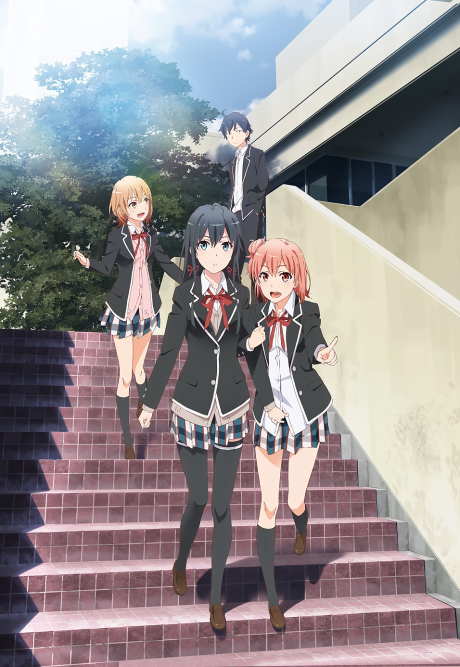
Yoshioka Futaba enters high school with a deliberate plan to reset her life and social image. During her junior high years, her attractive appearance caused her female peers to ostracize her, making genuine connections difficult. Furthermore, a significant misunderstanding prevented her from expressing her true feelings to the one boy she ever cared for, Tanaka-kun.
Determined to avoid past isolation, Futaba intentionally acts unladylike so her new classmates will not feel jealous or alienated. While navigating this carefully constructed persona and living contentedly, her path crosses with Tanaka-kun once again. However, he now goes by the name Mabuchi Kou and carries a distant demeanor.
When they speak, he reveals that he shared her mutual feelings during their younger days, shattering her lingering hopes by declaring that things can never return to how they used to be. This encounter upends her efforts to maintain a simple, uncomplicated high school experience, forcing her to confront unresolved emotions from three years prior while questioning whether her stalled romance has any remaining path forward.
What happens at the end of Blue Spring Ride?
Key takeaways
The provided source material leaves the ultimate romantic resolution between Futaba and Kou open-ended.
The narrative focuses heavily on Futaba attempting to reset her social image upon entering high school.
Past misunderstandings and changed identities create a barrier between the main characters.
Because the source material strictly provides only the initial premise and setup of Blue Spring Ride, the text does not detail the specific events of the final act, the closing scenes, or the ultimate resolution between Yoshioka Futaba and Mabuchi Kou. Consequently, the narrative leaves the ultimate fate of their rekindled connection completely open rather than providing a definitive conclusion based on unprovided facts. Without explicit textual evidence regarding the final episodes, one reading of the story suggests that the focus remains entirely on the emotional turbulence of youth rather than delivering a neat romantic payoff.
The initial interaction where Mabuchi Kou claims that things can never be the same sets a melancholic and challenging tone, and the provided information does not confirm whether they ever manage to overcome this emotional barrier. Furthermore, the final moments, the closing actions, and the very last spoken line of the story are simply not documented in the available facts, meaning any attempt to describe them would be pure guesswork. Instead, viewers must interpret how Futaba manages her ongoing desire to continue a romance that never truly started three years prior.
The story prioritizes the realistic difficulties of communication, shifting identities, and personal growth over an immediate resolution, keeping the characters suspended indefinitely in their transitional high school phase. This unresolved state highlights the fragile nature of adolescent encounters. The available details end abruptly with the conflict between their past shared feelings and Kou's current reluctance, leaving the final outcome unwritten in the source text. Therefore, anyone seeking a precise account of the final sequence must look beyond the provided source material, as the narrative deliberately leaves the door open regarding whether Futaba can successfully restart her stalled romance.
What does the ending of Blue Spring Ride mean?
One interpretation of the themes in Blue Spring Ride centers on the painful difficulty of recapturing the past and the heavy toll of adolescent social pressures. The narrative explores how misunderstandings and changing identities can erect seemingly insurmountable walls between people who once understood each other. Futaba's deliberate attempt to alter her behavior highlights the exhausting lengths to which teenagers go to fit in and avoid rejection, sacrificing authenticity for social safety.
Meanwhile, Kou's transformation and his assertion that things can never be the same embody the theme of irreversible time, suggesting that childhood innocence cannot simply be reclaimed upon entering high school. The core struggle revolves around whether old feelings can survive profound personal changes. Because the source material leaves the ending open, the thematic focus remains firmly on the lingering weight of unexpressed emotions and the complex journey of navigating adolescent identity, rather than delivering a tidy romantic conclusion.
Average audience ratings from the source database. Click a title to read its ending explained.
Blue Spring Ride ending FAQ
Does the provided text explain how Blue Spring Ride concludes?
The provided source material does not detail the final scenes or resolution of the narrative. Because of this limitation, the text leaves the ultimate fate of the characters entirely open rather than guessing a specific conclusion to their romance.
Why does Yoshioka Futaba want to reset her life in high school?
Yoshioka Futaba wants to reset her life because her attractive appearance caused her female peers to ostracize her in junior high. She also hopes to avoid past social isolation by acting unladylike to prevent jealousy among her new classmates.
Who is Mabuchi Kou and how is he connected to Futaba?
Mabuchi Kou is the new name of Tanaka-kun, the only boy Futaba ever liked in junior high. They shared mutual feelings years ago, but a misunderstanding kept them apart before he moved away and returned completely changed.
Can things ever be the same between Futaba and Kou according to the story?
When they reunite in high school, Mabuchi Kou explicitly tells Futaba that things can never be the same again. The source text leaves it open as to whether they manage to overcome this barrier and reconnect.
Is the romance between Futaba and Tanaka-kun resolved in the source material?
The available source material strictly outlines the setup of their reunion and does not confirm whether Futaba successfully continues her love. The narrative leaves the romantic progression open-ended rather than providing a definitive resolution.
After transferring into a new school, a deaf girl, Shouko Nishimiya, is bullied by the popular Shouya Ishida. As Shouya continues to bully Shouko, the class turns its back on him.