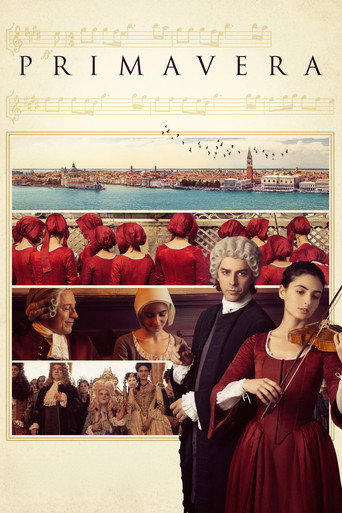
Set in early eighteenth-century Venice, the Ospedale della Pietà functions as a massive orphanage where gifted resident girls are trained in classical music to perform behind grilles for wealthy patrons. Facing declining audience numbers compared to rival institutions, the orphanage governor rehires Antonio Vivaldi as composer and teacher. Twenty-year-old Cecilia emerges as an exceptional violinist, winning Vivaldi's favor for first violin over her rival Laura during auditions of his La Follia variations.
Her impressive performance later captivates the visiting Frederick IV of Denmark during a newly composed sonata. However, the conclusion of the Ottoman-Venetian War brings Sanfermo, a veteran whose arranged marriage to Cecilia was brokered by the governor in exchange for a financial donation. Desperate to avoid a union that would permanently sever her ties to music, Cecilia takes drastic action by sleeping with Michele, the local greengrocer, intentionally failing the mandatory pre-marriage virginity examination to invalidate the contract and preserve her artistic future.
What happens at the end of Primavera?
Key takeaways
Cecilia escapes the orphanage to reclaim her autonomy after a devastating assault on her hands.
The narrative suggests that true freedom requires letting go of past obsessions and predefined destinies.
Vivaldi's music serves as both a catalyst for her courage and a backdrop to her ultimate departure.
The final act of Primavera unfolds with severe repercussions as the marriage is canceled, landing Cecilia in solitary confinement until Vivaldi successfully demands her release. To salvage the promised financial donation and quell malicious rumors suggesting Cecilia bedded the composer instead, the governor arranges for another resident to marry Sanfermo in her place. Seeking revenge for the perceived insult to his honor, Sanfermo arranges a private meeting with Cecilia.
Despite an initially calm demeanor, he viciously shatters her wrist and left hand, effectively ending her violin-playing career and sabotaging her upcoming participation in the premiere of Juditha triumphans, a grand piece commissioned to celebrate the end of the war. When Vivaldi questions her sudden absence, the governor deceives him by claiming Cecilia merely fell down the stairs, and though the composer suspects foul play, he ultimately lacks the bravery to retaliate on her behalf. During the grand premiere, Cecilia receives permission to listen from an upper side gallery.
After appreciating the opening movement, she manages to flee the orphanage with the direct help of the prioress, who shares her own childhood background of institutional abandonment. On the stage below, while the Doge, the Council of Ten, Sanfermo, and the enraptured audience shower Vivaldi with thunderous applause, the composer subtly realizes that his star pupil has vanished. The final sequence shows Cecilia boarding a boat to leave Venice behind.
In a powerful symbolic gesture, she discards the keepsake token left by her biological mother, finally freeing herself from the lifelong quest for maternal identity and closure. The story closes on an image of Cecilia smiling as she drifts away into an uncertain yet liberated future.
What does the ending of Primavera mean?
One reading of the conclusion is that art and self-preservation ultimately outweigh institutional and patriarchal control. Throughout Primavera, the Ospedale della Pietà treats its talented residents as commodities to be traded through marriages or displayed for financial gain. Cecilia's journey highlights the heavy cost exacted upon women who dare to step outside the paths chosen for them.
Her shattered hand symbolizes the physical violence used to suppress female autonomy and artistic expression within this rigid society. Yet, her subsequent escape reinterprets this tragedy not as a permanent defeat, but as a catalyst for complete reinvention. By throwing away the token from her mother, Cecilia sheds the emotional anchors tying her to an absentee past, suggesting that true liberation comes from abandoning the search for validation from those who abandoned us.
Vivaldi remains trapped within his privileged musical sphere, receiving applause while failing to act, highlighting the limits of artistic patronage against systemic cruelty. Ultimately, the film explores how letting go of painful origins and broken dreams can open the door to genuine personal freedom.
Average audience ratings from the source database. Click a title to read its ending explained.
Primavera ending FAQ
Why does Cecilia intentionally fail her pre-marriage virginity test?
Cecilia sleeps with Michele the greengrocer because marrying Sanfermo would force her to abandon her beloved violin and music forever. Failing the test legally invalidates the arranged marriage contract, allowing her to escape a life she never chose, even though it lands her in temporary solitary confinement.
Who breaks Cecilia's hand and why?
Sanfermo breaks Cecilia's wrist and left hand during a private meeting out of wounded pride. By refusing to marry him, she insulted his honor, and his violent retaliation permanently destroys her ability to play the violin, ruining her musical career.
Does Vivaldi try to avenge Cecilia after she is attacked?
No, Vivaldi does not avenge her. Although the governor lies and claims Cecilia was injured falling down the stairs, and Vivaldi suspects the truth, he ultimately lacks the personal courage to confront Sanfermo or defend his student.
What happens to Cecilia at the very end of the movie?
Cecilia escapes the orphanage during the premiere of Juditha triumphans with help from the prioress. She takes a boat out of Venice, throws away the keepsake token from her mother, smiles, and leaves her past behind to pursue a liberated life.
Why does Cecilia throw away her mother's token?
Throwing away the keepsake symbolizes Cecilia letting go of her obsession with finding her biological mother. By discarding the token, she frees herself from the emotional burden of her past and embraces an independent future defined by her own choices.
The story of Michael Jackson, one of the most influential artists the world has ever known, and his life beyond the music. His journey from the discovery of his extraordinary talen