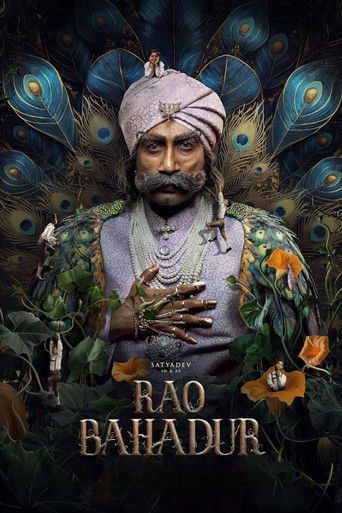
Set in 1970s India, the fantasy drama thriller Rao Bahadur follows Bhuvanam Ramappa Rao Bahadur, an eccentric and mentally unstable aristocrat living at his ancestral manor, Bhuvanalayam. Diagnosed with terminal liver cancer, Ramappa unexpectedly outlives his prognosis. His life is consumed by a paranoid obsession that his deceased younger son, Kusumappa, was not his biological child.
Ramappa's wife, Renuka, lives in self-imposed isolation in a dark room, while their elder son, Lavanappa, struggles under the emotional weight of his parents' turmoil. Only Ramappa's friend and physician, Dr. Srinivasa Achari, knows the full extent of his delusions.
Flashbacks reveal how Ramappa married Renuka after a surreal ancestral vision compelled him to preserve his lineage. Years later, rumors surrounding Kusuma's dark skin led to domestic abuse and eventually Kusuma's tragic suicide by drowning. In the present day, learning about DNA testing prompts Ramappa to secretly exhume Kusuma's remains. This act triggers a chaotic chain of events involving police investigations, accusations, and a court-ordered DNA test.
Bhuvanam Ramappa Rao Bahadur dies with a triumphant smile after a court-ordered DNA test proves he is the biological father of his deceased son Kusumappa.
During the funeral, Renuka confesses that her elder son Lavanappa is actually the illegitimate child from a previous relationship, not Kusumappa.
Dr. Srinivasa Achari reveals that Ramappa himself was adopted, adding another layer of deception to the family's obsession with bloodlines.
The story concludes with Lavanappa inheriting the manor as banyan roots creep toward him, symbolizing the continuation of the family's destructive cycle.
The final act of Rao Bahadur centers on the legal fallout and tragic revelations following the exhumation of Kusumappa's grave. As the court awaits the results of the DNA test on the exhumed skeletal remains, Ramappa slips into a deep Yogic sleep. The court eventually delivers its verdict, declaring scientifically that Ramappa is indeed Kusumappa's biological father.
Reassured that his royal bloodline remains unblemished and his paranoia seemingly validated, Ramappa passes away peacefully with a triumphant smile on his face. Following his death, the narrative shifts to his funeral, where Renuka approaches Ramappa's corpse and makes a shocking confession. She reveals to the dead man that Lavanappa is actually the illegitimate child, born from her previous relationship before she married Ramappa to secure a societal identity.
Furthermore, Dr. Srinivasa Achari admits that he had previously forbidden Renuka from revealing this truth, operating under the philosophy that everyone maintains their own version of truth. Adding to the web of deceit, Achari discloses that Ramappa himself was adopted after his own father's biological child was stillborn, meaning the entire obsession with ancestral purity was built on a foundation of inherited lies.
With the patriarch gone, Lavanappa formally takes his place as the new head of the ancestral manor. The final haunting image of the story shows banyan roots creeping out from the ancestral portraits toward Lavanappa as he sits, powerfully signaling that he has fully inherited his family's hollow pride and the inescapable, destructive cycle of generational obsession.
What does the ending of Rao Bahadur mean?
The ending of Rao Bahadur explores profound themes of inherited trauma, toxic pride, and the destructive nature of obsession. Ramappa's entire existence was dictated by a phantom need to preserve a pure bloodline, a delusion manufactured by his own mind and reinforced by ancestral pressure. The irony of the narrative peaks when scientific proof validates his fatherhood just as he dies, yet the ultimate truth reveals that the entire aristocratic legacy is a farce.
Renuka's confession exposes the hypocrisy of societal standards regarding legitimacy, while Achari's revelation that Ramappa was adopted highlights how generational curses are passed down through belief rather than biology. One reading of the final imagery is that the manor itself is a living parasite, feeding on the insecurities and vanities of its inhabitants. By having Lavanappa sit in his father's place while banyan roots advance toward him, the story suggests that breaking free from historical cycles is nearly impossible when individuals remain chained to the ghosts of their ancestors. Ultimately, the film uses its fantasy elements and tragic turns to examine how men become enslaved by artificial constructs of honor and blood.
Average audience ratings from the source database. Click a title to read its ending explained.
Where to watch Rao Bahadur
How
Available on
Stream
Netflix
Listed for region IN. Availability varies by country.
Rao Bahadur ending FAQ
What causes Ramappa's obsession in Rao Bahadur?
Ramappa's obsession stems from a paranoid suspicion that his younger son Kusumappa was not biologically his, fueled by rumors surrounding the boy's dark skin and influenced by surreal visions of his ancestors.
Does Ramappa learn the truth about his son before dying?
Ramappa dies believing he discovered the truth. A court-ordered DNA test on exhumed remains proves he is Kusumappa's biological father, allowing him to pass away with a triumphant smile.
Who is the biological father of the illegitimate child?
Renuka confesses at the funeral that Lavanappa is actually the illegitimate child conceived from her prior relationship before she married Ramappa.
What secret does Dr. Srinivasa Achari reveal?
Dr. Achari reveals that he advised Renuka to hide the truth about the children and discloses that Ramappa himself was adopted after his father's biological child was stillborn.
What do the banyan roots symbolize in the final scene?
The creeping banyan roots symbolize Lavanappa stepping into the same trap as his predecessors, inheriting the family's hollow pride and continuing its destructive cycle of obsession.
Where can I watch Rao Bahadur?
Stream: Netflix. Availability listed for region IN and varies by country.
The tragic love of Orpheus and Eurydice is intertwined with the complex relationship of Hades and Persephone. Eurydice, struggling with poverty, is lured to the industrial underwor