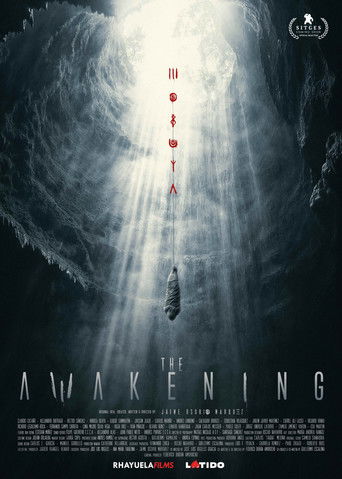
In the film The Awakening, set in 1921, author Florence Cathcart uses rational methods to expose fake spiritualists while secretly searching for a way to reconnect with her fallen fiancé from the First World War. Robert Mallory, a teacher at a remote boys' boarding school, approaches her to investigate the alleged haunting of a child ghost following a tragic death on the grounds. Although Florence initially declines, her shared background as an orphan compels her to accept the case.
Upon arriving, she uncovers a student prank and a teacher's cruel punishment that led to the fatal asthma attack. As the students and most staff depart for the holiday, Florence stays behind with Robert, housekeeper Maud Hill, and a remaining pupil named Tom. Strange occurrences soon plague Florence, including a near-drowning incident, terrifying apparitions, and a violent encounter with the groundskeeper Edward Judd. Robert helps her conceal the aftermath of that struggle, but mounting eerie phenomena begin to distort reality, blurring the line between the living and the dead as deeply buried secrets start to emerge.
Florence discovers that the haunting at the boarding school is tied to her own repressed childhood trauma rather than external spirits.
The terrifying events reveal that Tom is a ghost and Florence's forgotten half-brother, leading to a confrontation with her dark past.
Maud poisons herself and Florence in an attempt to keep them together as spirits, but Florence ultimately chooses life and healing.
The story concludes with Florence leaving the school, having made peace with her memories and her connection to Robert.
The final act of The Awakening shatters Florence's reality when Robert reveals an astonishing truth: there are no children actually residing at the school. This prompts a wave of forgotten memories to flood back into Florence's consciousness. She suddenly remembers that the sprawling boarding school was once her actual family home.
In a devastating sequence, she relives her childhood horror of witnessing her father murder her mother with a shotgun and attempt to hunt her down through the walls while calling out his pet name for her. She realizes her father accidentally killed Tom, who was his illegitimate son, before taking his own life. Florence had completely repressed these terrifying events, replacing them with a fabricated narrative of growing up in Africa.
It is then revealed that Tom is the child ghost haunting the halls, and Maud, who was her former nanny, is actually Tom's mother. Driven by a desire to reunite the family in the spirit realm, Maud poisons both herself and Florence. Realizing the fatal trap, Florence tells Tom that her soul cannot rest if she dies now, prompting the spectral boy to retrieve the antidote for her.
Florence survives the poisoning and wanders the school. She notices that most adults cannot see or hear her, suggesting a lingering threshold between the living and the dead, though she shares a brief greeting with Victor, a lonely boy who had also suffered from bullying. She finds Robert, shares a final cigarette and a kiss with him, and mentions that losing the ability to see ghosts does not equate to forgetting them.
Asking Robert to have the driver wait and promising to see him on Saturday week, Florence walks away from the grounds. As she departs, she exchanges friendly greetings with another boy on the lawn, leaving her ultimate physical state open to interpretation while marking a peaceful resolution to her internal torment.
What does the ending of The Awakening mean?
The narrative of The Awakening dives deeply into the psychological weight of grief, trauma, and the mechanisms of memory suppression. Florence's entire career as a ghost hunter stems from her inability to let go of her fiancé, symbolizing how the living become haunted by their own unresolved losses. The film explores how the human mind protects itself from unbearable trauma by burying horrific events beneath elaborate false memories, as seen in Florence's fabricated childhood.
Loneliness is portrayed as a magnetic force that draws out the supernatural, with ghosts acting as physical manifestations of abandonment and isolation. Maud and Tom represent the tragedy of a family torn apart by violence, whose spirits remain bound to the past because they cannot accept loss. Ultimately, the resolution suggests that true healing requires confronting the dark realities of the past rather than hiding from them. By facing her abusive father's actions and forgiving the lingering specters of her childhood home, Florence breaks the cycle of haunting and chooses emotional reclamation over a fatal union with the dead.
Average audience ratings from the source database. Click a title to read its ending explained.
Where to watch The Awakening
How
Available on
Rent
Amazon Video
Listed for region IN. Availability varies by country.
The Awakening ending FAQ
Who is Tom really in The Awakening?
Tom is revealed to be a ghost and Florence's half-brother, the illegitimate son of her father who was accidentally killed during the tragic murders at the family home years prior.
Why did Florence have false memories?
Florence completely repressed the horrific childhood memory of her father murdering her mother and trying to kill her, replacing it with a comforting fictional past in Africa to cope with the trauma.
What was Maud's role in the events?
Maud was Florence's former nanny and Tom's biological mother. She orchestrated Florence's arrival at the school because Tom missed her, and later poisoned them both to unite their spirits.
Does Florence die at the end?
The story leaves her ultimate physical state ambiguous after she recovers from the poisoning, walks away from the school, and interacts with people on the grounds while saying goodbye to Robert.
Why do ghosts appear in the story?
The film concludes that ghosts manifest specifically around the lonely and those suffering from profound grief, acting as physical representations of unresolved emotional pain and trauma.
Where can I watch The Awakening?
Rent: Amazon Video. Availability listed for region IN and varies by country.
Returning to the house where his family was brutally murdered during the war, "the man who refuses to die" dismantles it, loads it on a truck, and is determined to rebuild it somew