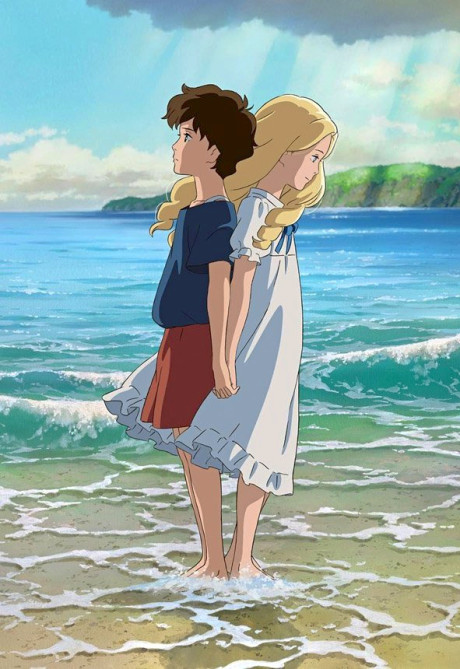
Twelve-year-old Anna Sasaki struggles with severe asthma, low self-esteem, and deep feelings of isolation while living with her foster parents in Sapporo. Following a severe asthma attack at school, her foster mother Yoriko sends her away to spend the summer break in a quiet rural seaside town with relatives, Setsu and Kiyomasa Oiwa. Hoping the clean air will improve her health and clear her mind, Anna spends her days exploring the local landscape.
During her wanderings, she stumbles upon a salt marsh featuring an abandoned estate known as the Marsh House. Although the building appears empty, Anna soon spots a mysterious blonde-haired girl named Marnie looking out from inside. The two quickly form a secret bond, meeting repeatedly at night near the estate.
Marnie introduces Anna to a world of parties and shared secrets, slowly drawing the introverted girl out of her shell. Anna also befriends a local painter named Hisako and meets Sayaka, a girl whose family moves into the Marsh House and hands Anna an old diary belonging to Marnie.
What happens at the end of When Marnie Was There?
Key takeaways
Anna realizes that Marnie is her grandmother, whose story she knew because she heard it as a baby.
The truth about her family background helps Anna heal from feelings of abandonment and low self-esteem.
Yoriko reassures Anna of her genuine love, leading Anna to finally call her mother.
The story closes with Anna seeing Marnie at the mansion window waving goodbye to her before leaving the seaside town.
The final act begins when Anna confronts Marnie about discovering government documents showing that her foster parents receive financial compensation for caring for her. Believing she is only loved for money and feeling deeply resentful toward her biological relatives for abandoning her, Anna turns her emotional turmoil toward Marnie. In return, Marnie confides in Anna about her own lonely upbringing, describing how her parents constantly traveled abroad and left her in the care of a cruel nanny and abusive maids who threatened to lock her inside a nearby silo.
Wanting to help her friend overcome her trauma, Anna leads Marnie to the silo. Marnie confronts her deep-seated fear of the structure, but during the ordeal, she starts calling Anna by the name of Kazuhiko. A fierce storm breaks out, and Anna eventually wakes up from a dream to find Marnie missing.
Sayaka and her brother soon discover Anna unconscious and running a high fever near the silo, bringing her back safely to the Oiwa residence. As Anna recovers, she confronts Marnie, intending to withhold forgiveness for being left behind in the silo. Marnie apologizes and explains she can no longer see Anna, prompting Anna to declare that she loves and forgives her anyway.
Following her recovery, Hisako fills in the tragic history of Marnie, explaining how she married Kazuhiko, suffered through his sudden death, placed her daughter Emily in a boarding school after a sanatorium stay, and ultimately raised her granddaughter after Emily and her husband died in a car accident. When Yoriko arrives at the end of the summer to bring Anna home, she presents her with a photograph of the Marsh House that once belonged to Anna's grandmother. Turning the photo over, Anna sees Marnie's name written on the back, realizing that Marnie is her grandmother and that she knew so much of Marnie's story because she had heard it as a baby.
Yoriko addresses the government payments honestly, reaffirming her genuine affection, and Anna refers to her as mother for the very first time. After saying farewell to her new friends, Anna looks back from the departing car to see Marnie at the mansion window waving goodbye to her.
What does the ending of When Marnie Was There mean?
One reading of the narrative is that it uses mysterious elements to externalize inherited trauma and unspoken family history. Anna struggles with a profound sense of rootlessness, believing that being an orphan means she was never truly wanted. By interacting with the manifestation of her grandmother Marnie, Anna unconsciously processes the generational pain of abandonment, loneliness, and grief passed down from Marnie to Emily and finally to herself.
The resolution suggests that true healing comes from understanding one's lineage and realizing that love transcends paperwork and tragic loss. When Anna accepts her past and hears the truth about Yoriko's genuine affection, the psychological barriers around her heart dissolve. The themes of memory, forgiveness, and belonging converge in the final moments, showing that Anna no longer feels like an outsider. Instead, she connects her past, present, and future, finding peace in the knowledge of who she is and where she comes from.
How When Marnie Was There rates against similar titles
Average audience ratings from the source database. Click a title to read its ending explained.
When Marnie Was There ending FAQ
Who is Marnie in When Marnie Was There?
Marnie is Anna's grandmother. Anna knew so much of Marnie's story because she had heard it as a baby.
Why did Anna feel so isolated at the beginning?
Anna suffered from low self-esteem and asthma, and she discovered that her foster parents received payments to care for her, leading her to question their feelings.
What happened to Marnie's husband Kazuhiko?
Kazuhiko died from a sudden illness when they were young adults, which caused Marnie immense grief and led to a temporary stay in a sanatorium.
Does Anna return to live with Yoriko at the end?
Yes, Yoriko arrives at the end of the summer to take Anna back home, and Anna finally calls Yoriko her mother after understanding the depth of her love.
Are Marnie's encounters with Anna real or supernatural?
One interpretation is that the story presents a journey of self-discovery through mysterious encounters tied to Anna's forgotten babyhood memories, though the exact nature is left open to interpretation.
The taxi driver Odokawa lives a very mundane life. He has no family, doesn't really hang out with others, and he's an oddball who is narrow-minded and doesn't talk much. The only p