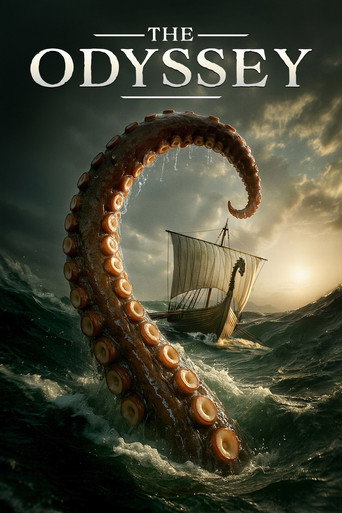
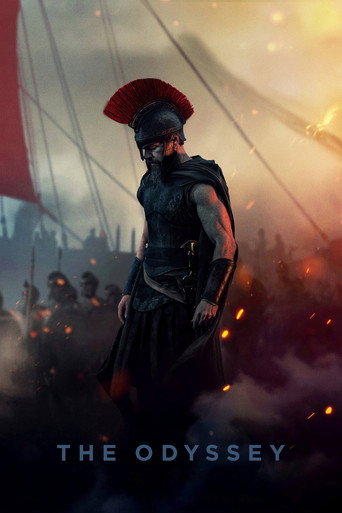
For two decades, King Odysseus remains missing following the Trojan War, leaving his kingdom of Ithaca vulnerable to ruthless suitors led by Antinous who desire his wife Penelope and the throne. Only Penelope, their son Telemachus, and the loyal servant Eumaeus keep faith. Telemachus ventures out to seek news of his father, while the goddess Athena urges Odysseus to leave the island of Ogygia and the nymph Calypso.
Flashbacks and underworld visions reveal Odysseus's agonizing voyage, marked by devastating encounters with the cyclops Polyphemus, man-eating giants, the witch Circe, sirens, and monsters. After losing his entire crew to divine wrath following the slaughter of sacred cattle, a memory-wiped Odysseus spent years with Calypso before finally washing ashore in Ithaca in disguise. Reconnecting with Telemachus, Odysseus learns of the constant danger threatening his family, setting the stage for a tense reunion and a reckoning inside the palace halls.
Odysseus reveals his true identity by successfully stringing his old bow and eliminating the aggressive suitors.
The narrative uncovers a darker truth about the Trojan War, painting the Greeks themselves as the destructive Sea Peoples.
Rather than reclaiming his crown, Odysseus abdicates in favor of Telemachus and chooses a path of exile with Penelope.
The final moments suggest a quiet journey westward, leaving past violence behind in hopes of a fresh beginning.
The final act commences with a tense feast where the disguised Odysseus, calling himself Sinon, confronts Antinous about past betrayals, leading to a brutal physical altercation that Telemachus interrupts. Later that night, in a private conversation with Penelope, the disguised king confesses to his profound guilt, admitting to violating sacred guest-host laws during the destruction of Troy, desecrating a temple statue, and inadvertently triggering the widespread collapse of the Late Bronze Age by masquerading as the dreaded Sea Peoples. He begs for her forgiveness.
The following morning, Penelope challenges the assembled suitors to string Odysseus's heavy bow and shoot an arrow through a line of axe heads, a feat none of them can accomplish. Odysseus steps forward, easily strings the weapon, and exposes his true identity. Instantly, violence erupts in the great hall.
Assisted by Telemachus, Odysseus systematically slaughters the suitors, including Antinous, until the survivors surrender. Instead of reclaiming his rightful crown and settling back into his former life, Odysseus chooses to step down permanently, handing the rule of Ithaca over to Telemachus. The story closes with Odysseus and Penelope departing together by sea, sailing west to honor fallen comrades, seek personal peace in exile, and look forward to a renewed civilization where time might finally wash away the memory of his past misdeeds.
What does the ending of The Odyssey mean?
One reading of the ending is that true redemption requires a complete abandonment of power rather than a mere restoration of the status quo. By stepping away from the throne, Odysseus acknowledges that his decades of violence and strategic deception have made him unfit to rule a peaceful Ithaca, passing the responsibility to the next generation through Telemachus. Another interpretation frames the conclusion as an exploration of guilt and historical consequence, linking mythological hubris to the real-world collapse of civilizations.
The revelation that the Greeks themselves were the dreaded Sea Peoples reframes the entire epic from a heroic journey against external monsters into an internal reckoning with human cruelty and imperial destruction. Sailing west into exile represents an escape from the cyclical nature of vengeance, suggesting that peace can only be found outside the structures of war and kingship. The final images emphasize the desire to be forgotten by history, contrasting the legendary fame of Odysseus with a quiet, humble existence shared with Penelope, leaving open whether true absolution is ever truly attainable.
Average audience ratings from the source database. Click a title to read its ending explained.
Where to watch The Odyssey
How
Available on
Rent
Amazon Video, Apple TV Store
Buy
Amazon Video, Apple TV Store
Listed for region US. Availability varies by country.
The Odyssey ending FAQ
Does Odysseus reclaim his throne at the end of The Odyssey?
No, although he successfully defeats the suitors and reclaims his household, Odysseus chooses to abdicate the throne immediately, handing the rule of Ithaca over to his son Telemachus before departing into exile with Penelope.
Why does Odysseus disguise himself as Sinon?
Odysseus adopts the alias Sinon as a symbol of his deep guilt regarding the Trojan War, echoing the name of the soldier sacrificed as a decoy during the creation of the Trojan Horse.
What is the truth about the Sea Peoples in the movie?
During his confession to Penelope, Odysseus reveals that the murderous Sea Peoples attacking the Mediterranean were actually the Greek armies themselves during their brutal sacking of Troy.
Why do Odysseus and Penelope leave Ithaca?
They leave Ithaca to seek peace in exile, sailing west to honor Odysseus's fallen soldiers and escape the violence and bloodshed that defined his decades away from home.
Is the fate of the remaining suitors resolved?
Yes, after Odysseus and Telemachus kill many of the challenging men in the great hall, the surviving suitors formally surrender, sparing themselves further bloodshed as Odysseus prepares to leave.
Where can I watch The Odyssey?
Rent: Amazon Video, Apple TV Store. Buy: Amazon Video, Apple TV Store. Availability listed for region US and varies by country.
The Odyssey cast
Actor
Character
Myrom Kingery
Odysseus
Morgan Flanagan
Penelope
Patrick Byrnes
Telemachus
Dominic Keating
Antinous
Llana Barron
Athena
Jordan Iverach
Polites
Tony Wood
Alkimos
Ashton Rogers
Eurylochus
Movie
★ 8.2
Ne Zha 2 ending explained
After a catastrophic event leaves their bodies destroyed, Ne Zha and Ao Bing are granted a fragile second chance at life. As tensions rise between the dragon clans and celestial fo